Stewardship Spotlight: Corda Ranch
August 18, 2020
Each year, MALT’s Stewardship Assistance Program (SAP) provides conservation planning expertise and funding to farmers and ranchers on MALT-protected farmland, supporting them as they care for the land. A number of critically important projects were completed over the last year, each one the result of strong community collaborations among multiple local and regional partners, and ranch agriculturalists.
One such project was recently completed on Corda Ranch, located just west of Petaluma and situated within the Petaluma River watershed. In partnership with the Marin Resource Conservation District, the USDA Natural Resource Conservation Science and Point Blue Conservation Science’s Students & Teachers Restoring a Watershed program, MALT’s Stewardship Assistance Program implemented restoration efforts along an eroding tributary of San Antonio Creek, which snakes through the ranch’s lowlands. Working together, this team of land stewards, conservationists, educators and students planted 90 willow sprigs and 30 buckeye trees along the creek’s banks. Forty-five naturally growing saplings were also protected in this collaborative effort to restore a sensitive riparian corridor.
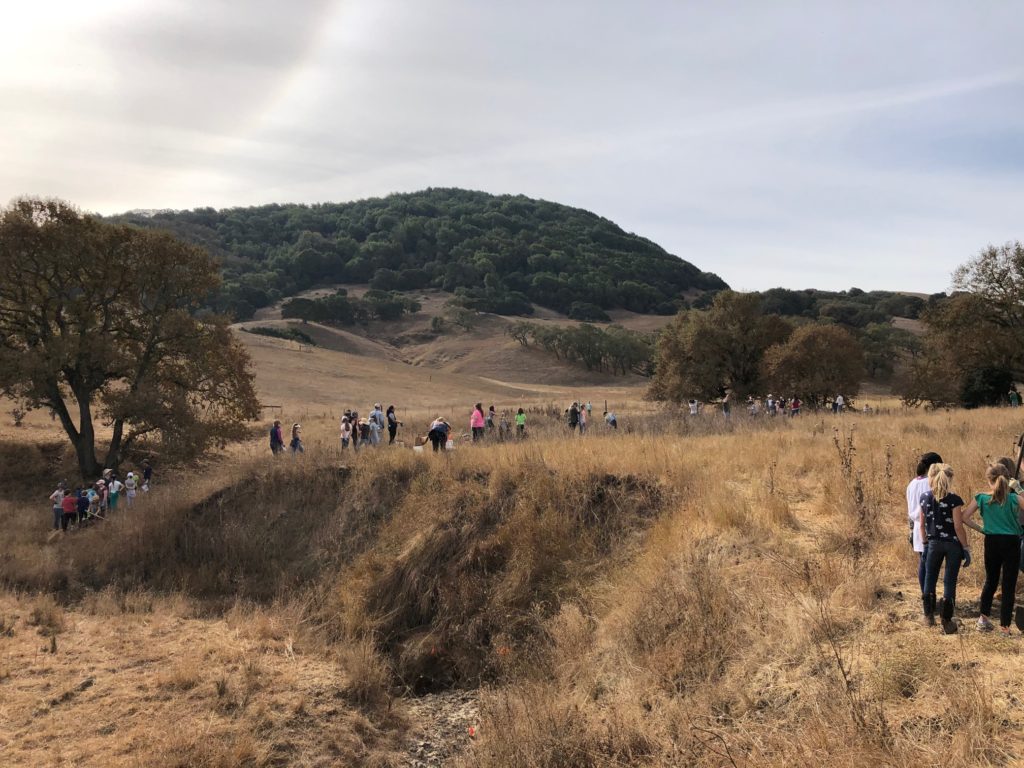 Students and teachers in Point Blue Conservation Science’s Students & Teachers Restoring a Watershed program prepare to plant willow sprigs and buckeye trees along a tributary to San Antonio Creek on MALT-protected Corda Ranch.
Corda Ranch is one of Marin County’s first carbon farms, and the ranch boasts a number of conservation practices that have been implemented over the years to increase organic matter in the soil. This, in turn, has enhanced the land’s water-holding capacity, bolstered the health of perennial vegetation and created critical wildlife habitat. This latest stewardship project will prove similarly impactful, resulting in creek bank stabilization and increased water infiltration in the creek’s floodplain. Combined with improved grazing management, these projects enhance the health of San Antonio Creek, which has been regionally identified as a restoration priority within the Petaluma River watershed. The plantings will also provide habitat for nesting birds and other species and help to capture and store more carbon annually.
Learn more about SAP today and how you can apply for and/or support this work!