This is Your Brain on Spring Grass

By Matt Dolkas,
Associate Director of Communications
May 8, 2026
There’s a wave headed straight for us. Marin County’s grasses have awakened from their winter dormancy, spring’s abundance cresting across our ranchlands. In anticipation, the ranchers here have all caught the season’s feverish mindset—you can see it in their eyes—working to get their livestock in the right places to make the most of this growing season.
Every year I seem to catch it too. Grazing our family’s land with goats is how we manage our wildfire fuels and I get feverish with the thought of using cattle to accelerate the work before the dry season, to catch the wave of grass growth and surf efficiently into summer. Just the thought of it keeps me up at night thinking through the animals, the fencing, the water, the possibilities.
This, apparently, is your brain on spring grass.
Good ranching isn’t about controlling the land. It’s about learning its rhythm well enough to move with it.
Marin’s Grass Season, Explained
To understand the feverishness in the ranching community come spring, you have to understand the relative scarcity of Marin’s growing season.
California, like other Mediterranean climates, is unique in that our grass grows in a relatively short period of time: The fall rains wake the seeds, triggering germination across the hillsides. Then, somewhere in February or March, the whole thing takes off. Growth can hit an inch a day in a late April warm spell. By late spring the plants have raced through their entire life cycle — building root, leaf, and stem before setting seed and shutting down for the long dry summer ahead.
Marin’s ranchers time everything around this cycle. Birthing happens in winter so mothers are lactating—producing the most milk—right when the spring grass peaks and there’s maximum food available. Catch it well and the land helps carry your operation for months—miss it and you’re buying expensive feed until next spring. But syncing with the grass is only half the equation.
The grass needs good ranchers just as much as the ranchers need good grass.
“Whatever the future of agriculture in Marin County looks like, one thing for sure is that it will be grass based.”
— Ralph Grossi, longtime Marin County rancher and MALT Board Emeritus
Grasslands Need Grazing
When grass is grazed, something remarkable happens underground. To rebalance itself, the plant sheds a portion of its roots—those roots decompose and become carbon locked in the soil. Then, as it regrows, it pumps even more carbon and energy back down into a deeper, stronger root system. Scientists call this root turnover, or root pumping. Grazed grassland plants, counterintuitively, end up building more soil than the ones left alone.
This is no accident. For thousands of years these grasslands thrived with the perpetual dance of herbivores grazing and predators chasing – moving constantly across the landscape, eating intensively, trampling everything, dropping dung, and moving on. Marin County’s grasslands evolved with this kind of impact. They don’t just tolerate being eaten. They’re built for it.
Take away the grazers and the system falls apart—grass grows tall and matted, shading out the soil, carbon cycles slow, diversity drops. A grassland without grazers is like a dancer without their partner. So, the ranchers chasing the spring flush aren’t just feeding cattle, sheep, and goats. They’re performing an ecological function as old as the dirt.
The question is simply how to graze it best.
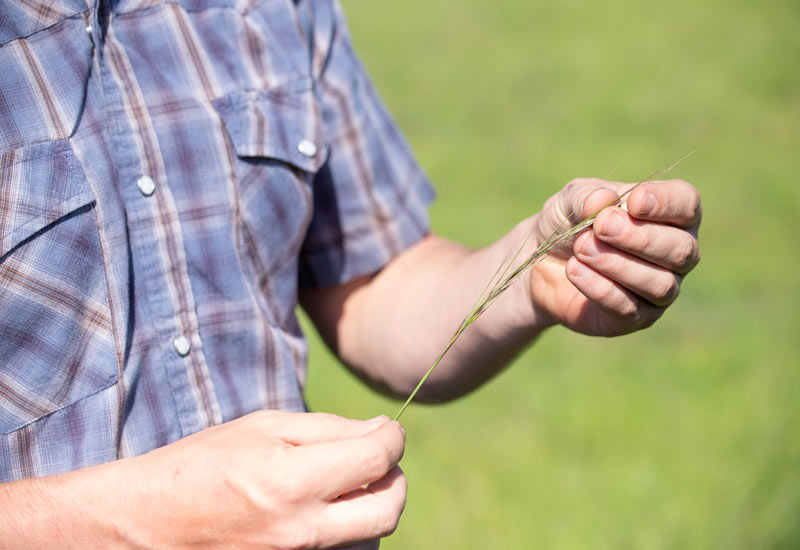
The relationship goes both ways—good ranching makes for good grass, and good grass makes for good ranching.
Rotational Grazing 101
There’s something deeply satisfying about knowing your place in the order of things. My monkey mind seems wired for the orchestration of managing grasslands—moving animals across the land in sequence, reading the grass, timing the rotation. It’s what I imagine when I lie awake at night, where to move our goats next, the juggling of the land’s complexities.
The practice has deep roots. In the 1950s a French farmer and biochemist named André Voisin spent years watching his cattle graze and arrived at a simple insight: the rest period is everything. Give the grass enough time to recover and it comes back stronger every time.
A decade later, Allan Savory formalized the idea into what he called holistic planned grazing, arguing that carefully managed animal impact could reverse land degradation, and even help to reverse climate change when done at scale and as part of global planning efforts. The science is still debated and is context-specific, but the core principle has held across generations:
Move livestock often. Give the land sufficient rest. Repeat.
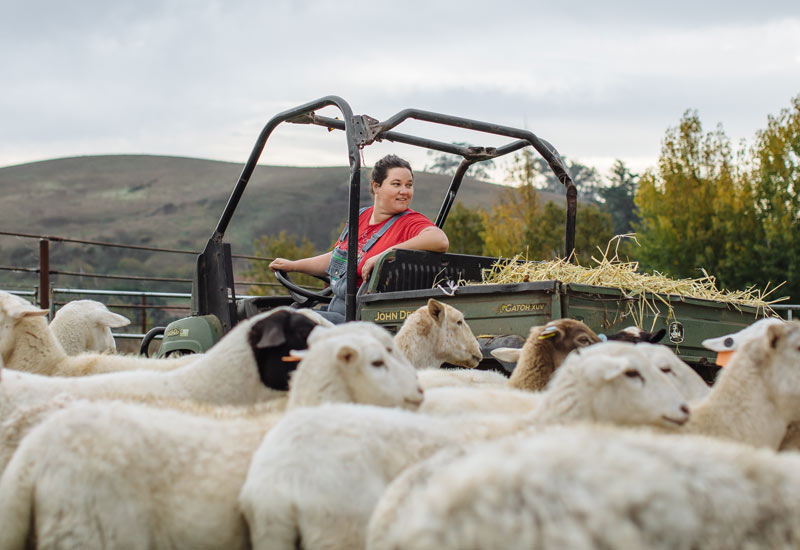
Jenna Coughlin, Shepherds of the Coast — tending her flock through the winter months.
Right now, many Marin ranchers are doing exactly this, spreading animals across as much land as possible, rotating between paddocks and thinking about how to protect winter forage reserves on their home ranches. With the grass growing fast and the soil still moist, grazed land recovers quickly—a paddock rested for a few weeks in early May comes back with vigor. That window closes as the dry season sets in. Part of the spring’s feverish mindset is knowing that the opportunity to improve the land is right now, while the iron is hot.
Of course, this kind of precision in Marin’s ranching takes investment — the right fencing, water infrastructure, the tools to manage animals across multiple paddocks. It’s one reason MALT’s small grants program exists, providing capital to help our farmers and ranchers upgrade the infrastructure needed to graze and grow smarter.
“Rotational grazing is the right thing for the land,” says Bill Dellinger of Ledger Ranch, a previous small grant recipient. “But it’s also just good business—done right, you can run more animals and the land can keep getting better every year.”
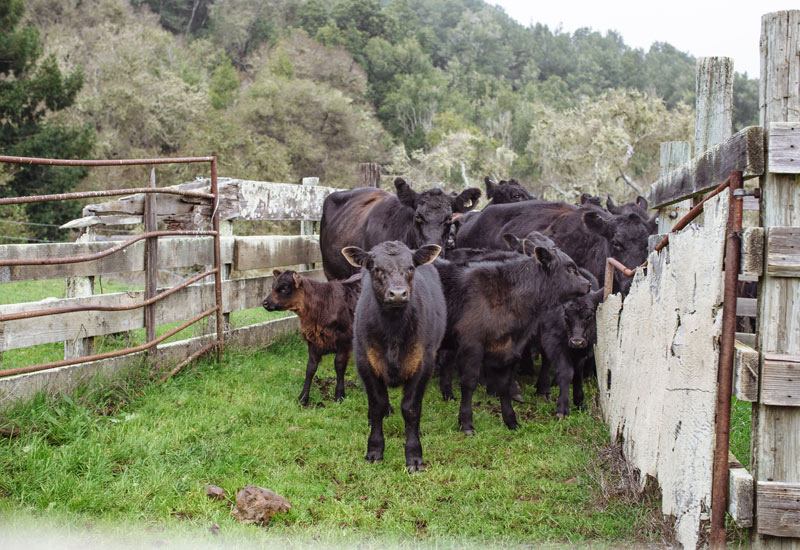
The only thing that tempers the spring grass fever is hard physical labor—a good sweat from work tending to livestock.
The more time I spend in Marin County, the more I realize how much I still don’t know. But each wave of spring grass teaches me a little more and carries me a little farther. Agriculture in Marin County, I’ve come to understand, has always been in flux—an economy dependent on national markets, consumer demand, climate variability, policy changes—the pressures that surely keep ranchers up at night. But underneath all of it, the grass keeps growing.
As Ralph Grossi, longtime Marin County rancher and MALT Board Emeritus, put it: “Whatever the future of agriculture in Marin County looks like, one thing for sure is that it will be grass-based.”
Want To Be Part of This Landscape?
Supporting MALT is one way in.