Why Cowboys Still Wear Blue Jeans

By Matt Dolkas,
Associate Director of Communications
April 29, 2026
It’s embarrassing to admit, but for the past few years I’ve been actively pretending to be a cowboy. I start most mornings with Toby Keith’s “Should’ve Been a Cowboy” playing on repeat in my head. It started with wrestling goats — learning to manage a small herd on our twenty acres just north of San Francisco — and somewhere along the way became a full romantic obsession with the cowboy way of life. The hat. The boots. The jeans. The whole enchilada.
I’m not alone in this. There’s something about cowboy culture that gets into people — a realness, a way of being that carries a kind of status you can’t manufacture. Everyone wants it but I think few people know what it actually costs. I’ve spent a few years now trying to figure out what it is — and of course, the best parts of my education came from a horse.
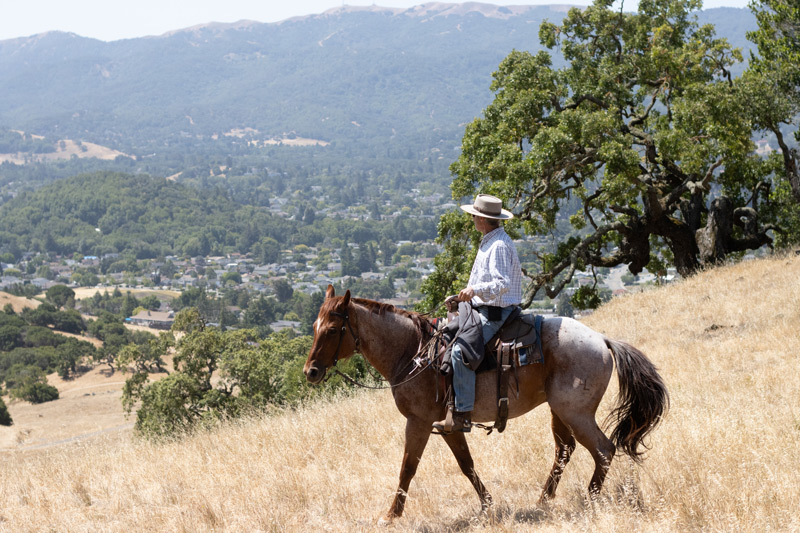
Gordon Gildroy, a local cowboy from Tomales, on the hunt for stray cows above Novato.
You can’t fake things around horses — they’re mirrors, reflecting back exactly what you bring.
I remember working with one of our family’s horses, Kevin, trying so hard to become a better rider that I couldn’t even get him to walk. Seriously, he just wouldn’t move. I felt like a toddler wrestling with his dad’s clenched fist, finger by finger, certain that enough effort would force it open. What Kevin was telling me was simple: Ask nicely.
But the lesson he was offering took me longer to see. When you get quiet enough to feel what a horse is telling you, you start noticing other things too. How a pasture holds itself differently in spring than in fall. How the ground changes under your feet through the wet corner by the fence. How a rancher reads a hillside the way you’d read a person’s face.
That gentleness, it turns out, is the whole job.
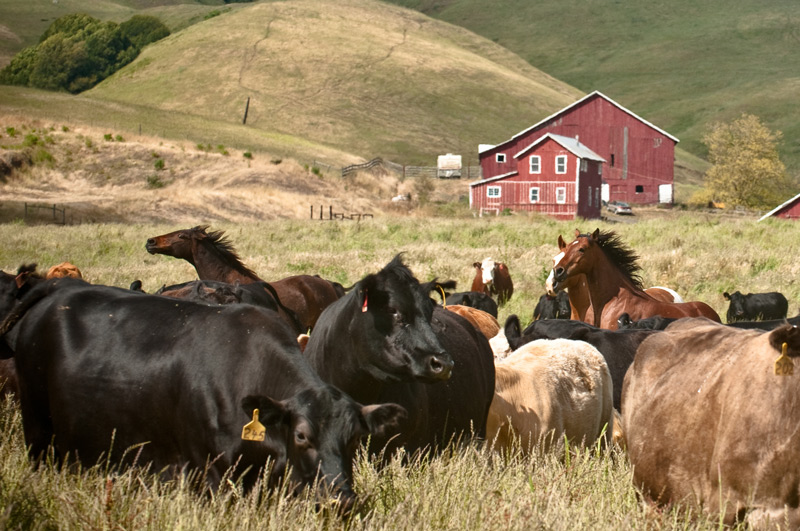
Excitement at the MALT-protected Red Hill Ranch, where careful grazing shapes the land. Photo: Michael Woolsey
We’ve been losing the fight against French broom on our family’s land for years. It’s invasive, aggressive, relentless. It moves into disturbed ground and doesn’t let go. For a long time I treated it the way I’d treated Kevin that afternoon: as a problem to overpower. Then I did what Kevin had been trying to teach me and stopped looking at it as a problem and started seeing it as a solution.
French broom is a legume. It fixes nitrogen, stabilizes poor soil, and below the surface its roots are in quiet conversation with fungi and microbes, a community so complex we’re only beginning to understand it. Our goats eating it down aren’t just removing a weed. They’re exposing sunlight, waking dormant grasses, helping the land move toward its next chapter. The broom did its work. Now the goats are doing theirs. And somewhere underground, that whole relationship is being written into the soil.
This is what I’ve come to think land management actually is: less like solving a problem and more like surfing. You don’t muscle a wave into submission. You read it, feel where it wants to go, and try to stay on your feet on the way down.
The careful grazing of livestock on Marin County’s coastal grasslands isn’t adjacent to conservation. It is conservation.
Cowboys and cowgirls of the American West have always known this. They’re not separate from the landscape. They’re essential to it. The careful grazing of livestock on Marin County’s coastal grasslands isn’t adjacent to conservation. It is conservation.
Ranchers don’t talk about any of this much. They’re just doing the work, day after day, season after season. There’s no performance in it. The jeans aren’t a statement. They’re just clothes that work because they always have. The question of identity — who they are, how they appear — doesn’t seem to come up. They just know. And the jeans fit.
We’ve built a world that rewards efficiency. Screens, algorithms, machines making decisions we used to make by feel, patience and good timing. And somewhere in all of that we’ve forgotten we’re animals too — creatures with bodies and instincts, capable of a kind of knowing that only comes from being present in a place over time. The ranchers I’ve come to know never forgot this. They can’t afford to.
I believe in the people who chose a place, committed to it completely, and built something that compounds over generations. In a culture that worships disruption and novelty, that kind of rootedness is rare. And increasingly, it’s everything.
So I’ll keep wearing the jeans and playing cowboy — a small act of orientation every morning, a reminder of what I’m paying attention to, and who taught me how.
Marin County’s farmland doesn’t protect itself. MALT does.