Reviving the Truttman Ranch, Protecting Public Grasslands

By Matt Dolkas,
Associate Director of Communications
January 7, 2026
When Levi McIsaac shakes your hand, you feel it—the confidence that comes from knowing exactly who you are and where you fit. Fifth-generation Marin County rancher. National Park Service (NPS) road crew worker. Someone who understands that his family’s future is inseparable from the health of the landscape they steward.
That confidence matters now more than ever. Just months ago, the future of ranching on public lands within Marin County hung in the balance. A years-long legal standoff culminated in a January settlement that eliminated twelve historic operations within the Point Reyes National Seashore.
Levi and his sister Courtney are now among just a few long-time ranching families still operating on Marin County’s public lands. Courtney handles the day-to-day ranch operations while Levi helps after work in the evenings and weekends.
In 1983, the NPS purchased the family’s home ranch near Olema, but the McIsaacs continued ranching under a lease agreement—a relationship that has spanned four decades and multiple generations. This January their new lease with the NPS expanded their operation from 2,300 to over 3,000 acres by incorporating the historic Truttman Ranch.
 Caring for cattle means caring for the land—healthy animals enable healthy grasslands.
 Levi McIsaac installing new water infrastructure at the his home ranch.
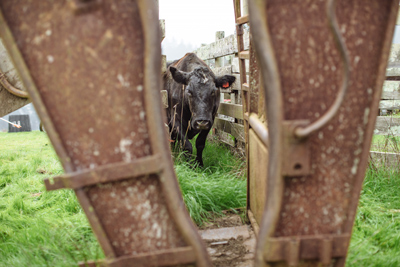 Health checks at the squeeze chute ensure cattle can thrive while managing grassland habitat.
But the expanded operation presented immediate challenges. The Truttman Ranch’s aging water systems needed rehabilitation to once again be functional—key infrastructure needed to meet the conservation grazing standards set by the NPS. That work required capital the family didn’t have on hand and funding the federal government couldn’t provide.
A $40,000 Marin Agricultural Land Trust (MALT) grant—part of $200,000 awarded in 2025 as part of its small grants program to ranchers across Marin County managing public and private lands for both agricultural and ecological outcomes—made the difference.
The Economics of Stewardship
This is the reality of public lands ranching in 2025. Federal agencies recognize that well-managed grazing serves conservation objectives—preventing fire risk, maintaining habitat for wildlife, controlling invasive species—but can’t fund the infrastructure that makes quality land management possible.
Strategic investment from nonprofit organizations like MALT fills that gap. When ranching operations have the tools they need to succeed economically, they can be excellent land stewards. When they’re barely hanging on financially, environmental goals become impossible luxuries.
Agricultural viability isn’t separate from conservation outcomes—it’s the foundation that makes those outcomes possible.
“The bones are good here at the Truttman Ranch—the water systems, the pastures,” Levi reflects. “We just need to rehabilitate what’s already in place.” For him and Courtney, the infrastructure investment represents more than immediate improvements—it’s about building capacity to steward these lands for another generation.
A Template for Public Lands
With small grant funding from MALT, the McIsaacs installed a new 3-horsepower pump system, upgraded electrical components, and added four strategically placed troughs connected by an existing 26,000 feet of pipeline at Truttman Ranch. At their home operation, creek-side infrastructure was relocated to higher ground with new storage tanks and 4,000 feet of new pipeline directing water away from endangered steelhead and coho salmon habitat within McIsaac Creek.
This new infrastructure allows the family to move cattle strategically across the landscape. Instead of animals concentrating around a few water sources—overgrazing some areas while leaving others untouched—the troughs and pipeline enable rotation that keeps the grasslands healthy and protects sensitive creek habitats.
“This land needs active management to stay healthy,” Levi explains, walking ground that now supports his cattle. “Coastal prairie evolved with large herbivores moving across it. Without that, the brush takes over and you lose the grassland habitat that’s key for so much wildlife.”
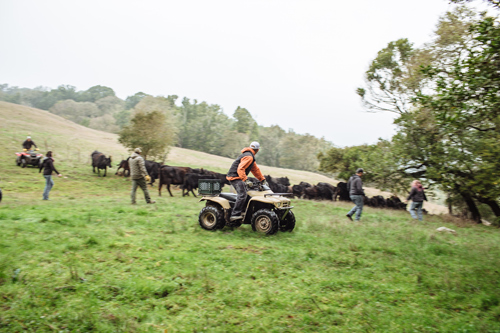 Moving cattle at the Truttman Ranch, where rotational grazing protects grasslands and creek ecosystems.
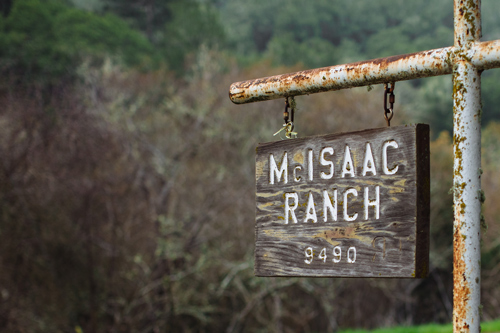 The McIsaac family has ranched this land for five generations—first as owners, now as lessees on public lands.
 Fifth-generation ranchers Levi and Courtney McIsaac manage over 3,000 acres of public grasslands in Marin County.
More Than Infrastructure
The Truttman Ranch rehabilitation isn’t just about one family’s operation. It’s about what becomes possible when we invest in the economic health of agricultural businesses that steward public lands. When we recognize that farming and ranching families need viable operations to stay on the land—and that their presence, when supported with the right tools, creates value far beyond their individual enterprises.
MALT continues to invest in conservation grazing and land stewardship projects across Marin County through its small grants program and other land stewardship efforts—supporting ranchers and farmers working to increase resilience on working lands while delivering ecological and community benefits.
“This grant helped us put the Truttman Ranch back into productive agriculture,” Levi says. “That’s what we needed to keep going.”
It’s this kind of targeted support—investments in working families who steward Marin’s ranchlands—that makes MALT’s conservation model work. The Truttman Ranch has been revived, the infrastructure repaired, the grasslands nourished, and a fifth-generation operation has the tools to become a sixth.
Photos by Michael Woolsey
Support Conservation Grazing
Projects like the Truttman Ranch infrastructure rehabilitation represent MALT’s commitment to investments that strengthen agricultural viability while advancing conservation goals.
Help fund partnerships that create lasting benefits for ranchers, land, and community.