What’s Living in a Handful of Dirt

By Peter Fugazzotto,
Director, Communications
October 5, 2026
Pick up a handful of healthy soil. A teaspoon of it holds more living things than there are people on earth. You are cradling a city, but one where most of its residents are hunting each other: eyeless entities, decomposers, predators. This time of year it seems worth saying out loud: the scariest thing in the pasture is lurking in the ground.
The fungal network beneath the grass
Start with the fungi. Not a plant. Not an animal. Something entirely its own. Thread-thin filaments creep through the dark of the soil, finding plant roots and splicing in. The fungus reaches water and minerals the roots never could and hands them over, and the plant pays in sugar. Not an invasion. A deal. Underground, the whole landscape is wired together this way, root to root, by something with no eyes and no plan.
Soil nematodes, by the million
Then the roundworms. Nematodes, millions of them in a square foot, more animals than you can picture. Some go after roots and give farmers a bad week. The rest graze. They crop bacteria and fungi the way cattle crop grass, and what passes through them comes out as food for everything else. Nitrogen moves through a worm smaller than a grain of salt.
The decomposers that turn leaves into soil
Up in the leaf litter, the shredders do the slow work. Millipedes, mites, springtails, the pale grubs of beetles. They break the dead down into smaller dead until a leaf is no longer a leaf and starts being soil. The shredders are patient. They are not in a hurry. They have all winter.
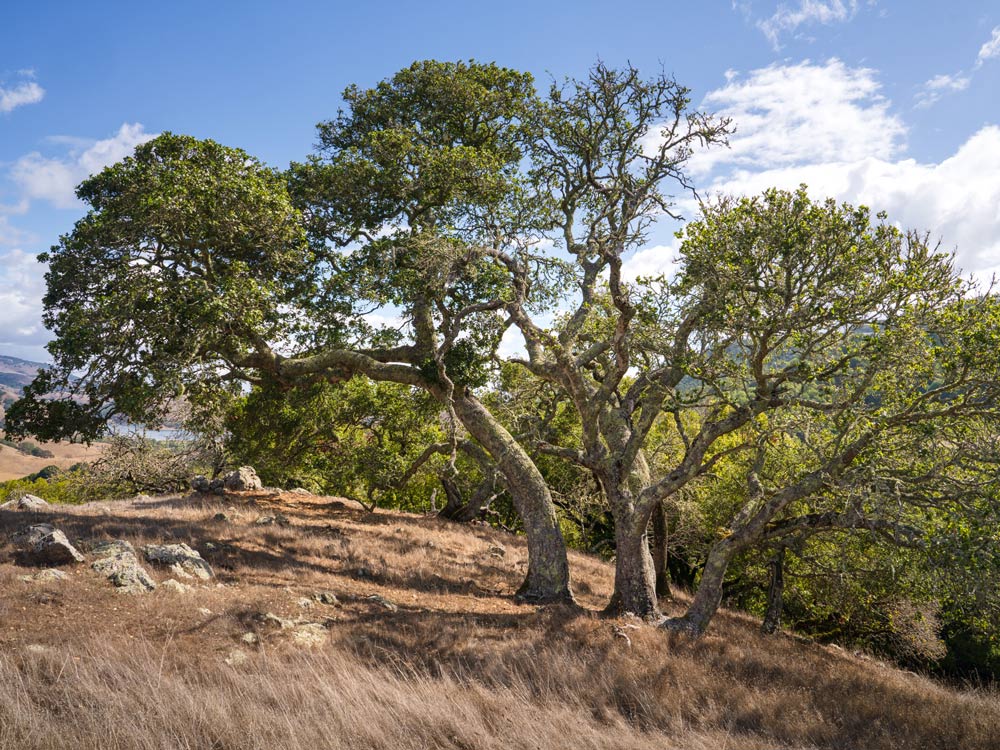
A valley oak above Marindale. Its leaf litter feeds the dark below. Its acorns feed nearly everything that creeps, flies, and burrows above.
Predators in the dark
Something is always hunting in the dark. Centipedes run the galleries on too many legs, fast, venomous at the front, eating anything soft enough to swallow. Predatory mites do the same at a scale you need a lens to watch. Nothing down there dies of old age. Nothing down there dies without serving a bigger purpose.
Why soil smells like rain
And after it rains, that smell. Clean, mineral, unmistakable. Is this finally a moment of relief? No. That is actinobacteria, finished with their own dead and announcing it. You have been breathing the exhaust of microscopic decomposers your whole life and calling it the smell of rain.
What it means for the land above
None of this dark world shows up in a photograph of a pasture. The grass looks like grass. But the reason it comes back green every year is the quiet carnage going on beneath it, billions of small mouths turning death into the next season.
So this month, while the decorations go up, spare a thought for the real haunted ground. It’s under your boots, and it’s doing fine.
If the dirt isn’t crawling, it isn’t working.
Marin’s Farmland Doesn’t Protect Itself, MALT Does