Bill Dellinger: A Tomales Rancher Is Writing His Own Grazing Playbook

By Matt Dolkas,
Associate Director of Communications
November 16, 2026
On the Ledger Ranch near Tomales, Bill Dellinger is making a deliberate bet on slow, dry-season grazing, built for the short growing season of California’s Mediterranean climate.
Knee-deep in a pasture gone gold and dry, untouched by summer grazing, Bill Dellinger points out the feed he is saving for the dry months ahead. “Basically, we’re trying to make standing hay,” he says.
Plenty of ranchers graze standing grass through the dry season. What’s different about Bill is intention. Rather than treat slow, stockpiled grazing as one tool among many, he has reoriented his whole operation around it—committing to refine it, prove it, and make it the way he ranches.
The payoff could be real. As he puts it, doubling production through good grazing is like buying another ranch for the cost of daily management. If careful grazing lets him run a bigger herd on the land his family already has, that is land he never had to buy—which, in a county where land is nearly impossible to afford, is increasingly how the next generation stays in business.
Agriculture is familiar territory for Bill, who grew up at the MALT-protected Hicks Mountain Belvedere Ranch, where a 4-H project he started as a kid grew into Hicks Mountain Hens, a pasture-raised egg business. When the family sold a conservation easement on Hicks Mountain to MALT in 2024, the sale funded the purchase of the nearby Ledger Ranch, where he now runs the family’s herd.
Cattle move through gold grass on Ledger Ranch, the dry-season feed Dellinger builds his whole operation around.
He’s stepping into the cattle business with real grounding: a lifetime ranching, years managing rotationally grazed cattle professionally, and a deep study of Holistic Management—the framework Allan Savory built on the idea that livestock, moved the right way, can rebuild land rather than wear it down. For Bill, that idea reframed everything: the herd isn’t a burden the land carries, but the tool that makes it healthier.
No Recipe for this Country
Rotational grazing looks different everywhere it’s practiced, shaped by the land and weather it answers to—and Bill has never found a model built for a Mediterranean climate like Marin’s. So he assembled his own, drawing on the methods of more than a dozen practitioners and bending them to his circumstance, his ranch.
What governs grazing in Marin County, and for most of California, is the fact that it only rains for part of the year. Grass greens up with the fall rains, idles through winter, makes one short burst of spring growth, then goes dormant as the summer heat sets in and the hills turn gold.
For the long dry months after, there is no regrowth—only the grass that already grew. Where ranchers in wetter landscapes can rotate their animals to keep grass growing, Bill’s aim is different: to make a fixed supply last.
“Doubling production through good grazing is like buying another ranch for the cost of daily management. “
None of it works without water available across the ranch. Bill’s close, move-them-often management is only possible because he can water the herd in any paddock on the ranch—a network of pipes, pumps, and troughs laid in 2025 with a MALT small grant.
The grazing shapes the herd, too. Because his cows have to do well on rough, mature grass rather than tender regrowth, Bill favors smaller-framed animals that eat less and let the same ground carry more. He is even weighing a cross with Mashona genetics—a small African breed that browses as well as grazes and thrives on poor, dry-season feed—on the logic that a different grazing strategy may call for an entirely different cow.
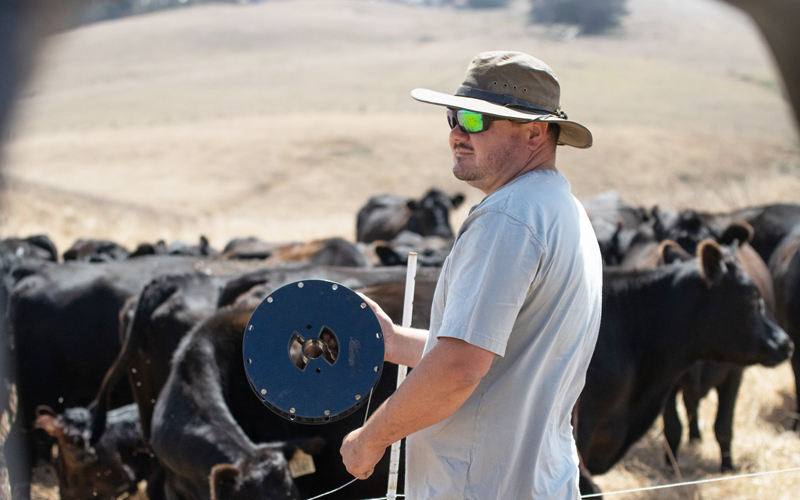
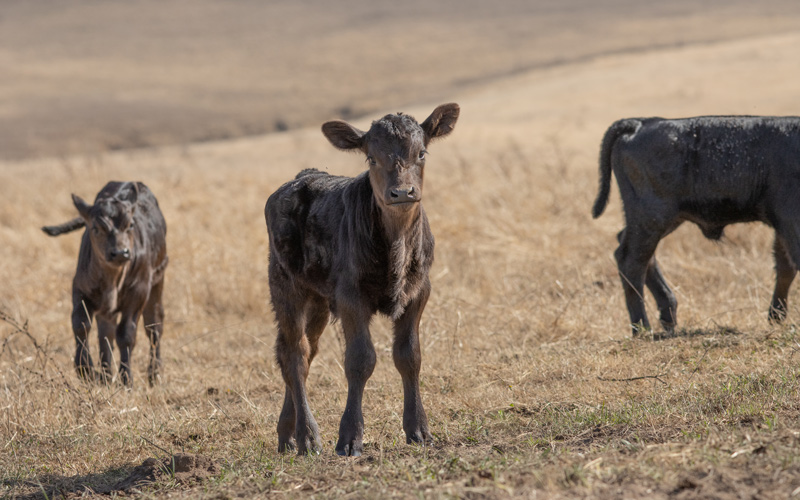
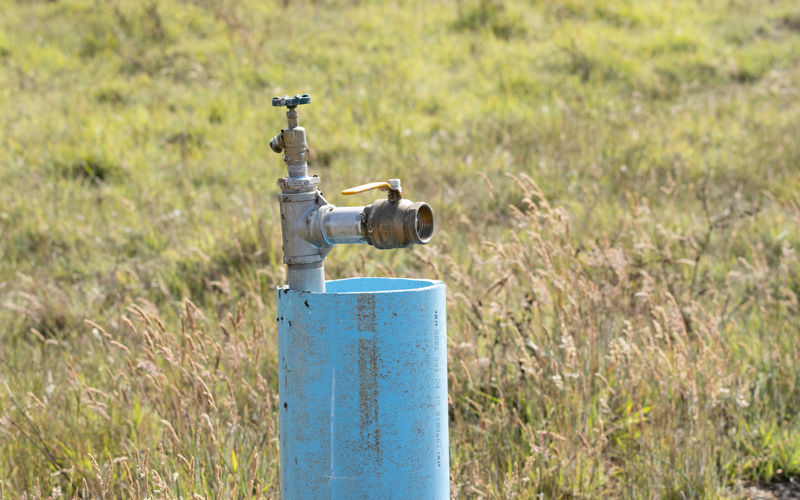
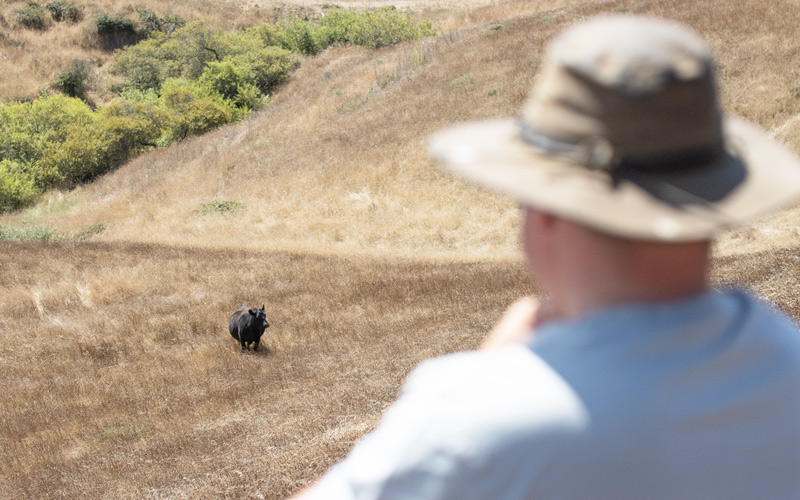
Clockwise from top left: Bill winding a reel of electric fence; a new calf finding its legs in the dry season; the finished water system; Bill working out how to gently bring a loose cow back to the herd.
A Family Endeavor
Bill is still proving the model out, and like good ranching, that takes patience. He is, in a sense, doing what he has done since he was a kid with a flock of laying hens: taking what he’s been handed—the land, the tradition, the hard local facts—and building something of his own.
None of it happens alone. From the egg stand to the water lines, the ranch has been a family effort, shaped by the daily work and steady support of his mother and brother. “We have a lot of work to do,” he says, more than once—the words of someone less interested in carrying on a tradition than in shaping what comes next.
This story is part of our Changemakers series, exploring the next generation of farmers and ranchers shaping the future of West Marin agriculture. More stories coming soon.