Marin County Approves Funding to Protect Tunnel Hill Ranch in Tomales
April 7, 2026
The Marin County Board of Supervisors voted today to approve a grant through the county’s Measure A Farmland Preservation Grant Program to help permanently protect the 110-acre Tunnel Hill Ranch in Tomales. The Marin Agricultural Land Trust (MALT) will use this grant, combined with private donations, to purchase a $1.1 million agricultural conservation easement on this iconic property at the northern entrance to town. This will be MALT’s 99th easement.
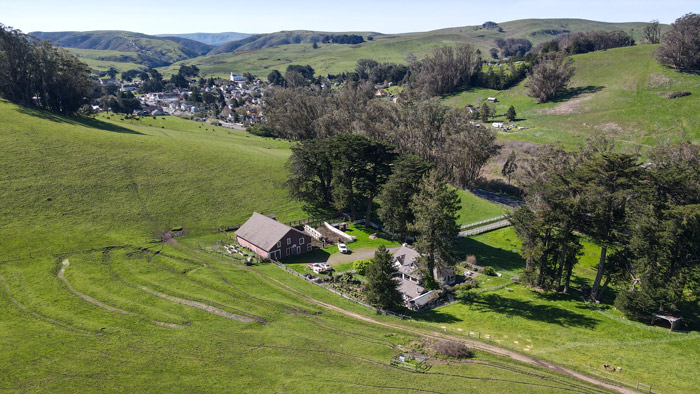
Owned by the Etemad family since 1976, Tunnel Hill Ranch sits prominently along Highway 1, defining the rural character that greets visitors and residents as they enter this small rural town. The property takes its name from the historic North Pacific Coast Railroad tunnel that runs beneath the land — a remnant of the region’s transportation heritage dating back to the 1880s.
Protecting Tomales’ Gateway
Tunnel Hill Ranch is a cornerstone of the region’s agricultural landscape, right at the community’s doorstep. Protecting it ensures this land remains in active agricultural use — with the potential to feed this community for generations to come. Nearly 40 percent of the property is classified as Farmland of Local Importance by the California Department of Conservation, yet its five parcels and four separate legal lots have made it a persistent target for development, drawing consistent interest from land developers due to its proximity to downtown Tomales and higher-density zoning on portions of the property.
“This property sits at a critical location — the hillside that defines Tomales’ northern gateway,” said Zach Mendes, MALT’s Director of Land Protection. “Protecting it ensures this community retains its agricultural identity and productivity for future generations.”
Jacqueline Etemad recalls overhearing a conversation at Tomales’ annual gathering in the town park: “Somebody said, ‘Well, who owns that property up there?’ And someone else replied, ‘Oh, that belongs to the town — that has to stay. That’s ours. Nobody can take it from us.'” The exchange, she says, reflected how the community already viewed the hillside as part of Tomales’ shared identity.
“We’ve had interest from land developers over the years, but this land plays an essential role in what makes Tomales special,” said Jeff Etemad, who helps manage the ranch with his mother Jacqueline and brother Gregory. “My mother wanted to ensure this property would be protected in her lifetime. The easement allows us to keep the property in the family and in agriculture while ensuring it can never be subdivided.”
What makes the Tunnel Hill Ranch easement distinctive is not just what it protects—but how the Etemad family thought about what to include and what to leave out. Before approaching MALT, the family identified which parts of their property belonged in agriculture and which didn’t. The ranch’s productive agricultural land will go into MALT’s easement. Several small parcels along Highway 1 and John Street, zoned for village commercial and residential use and tucked within the existing fabric of Tomales, were set aside regardless of what the family ultimately decides to do with them.
“We identified what should stay in agriculture forever and protected it with MALT,” said Jeff Etemad. “The parcels adjacent to town were always a natural extension of Tomales. Whether or not we ever develop them, keeping those options open is the right call for the community.”
This approach reflects how MALT’s conservation work is evolving. Protecting farmland remains the foundation, but MALT’s newly adopted strategic framework places growing emphasis on ensuring that land conservation supports the long-term viability of agriculture and the communities that depend on it — including how protected land fits into the broader needs of the towns and people it surrounds.
“Measure A was designed to protect exactly this kind of property,” said Lily Verdone, MALT’s Executive Director. “Protecting this land ensures the working farms and open landscapes that have shaped this community for generations remain part of Tomales’ future.”
Future Vision: Regenerative Agriculture
The Etemad family has bigger plans than simply preserving what’s there. The next generation is looking to expand the ranch’s agricultural productivity, with an eye toward practices that connect land health to community health.
“We’re interested in implementing more intensive rotational grazing, potentially introducing sheep, and exploring organic vegetable production,” said Jeff Etemad. “We see direct links between healthy land, healthy food, and healthy communities.”
The family has already begun experimenting with intensive rotational grazing practices on a five-acre pasture. As part of the easement agreement, they’ll work with MALT to develop a comprehensive agricultural management plan that will guide future improvements including additional cross-fencing, enhanced water infrastructure, and diversified livestock operations.
Strengthening Protected Landscapes
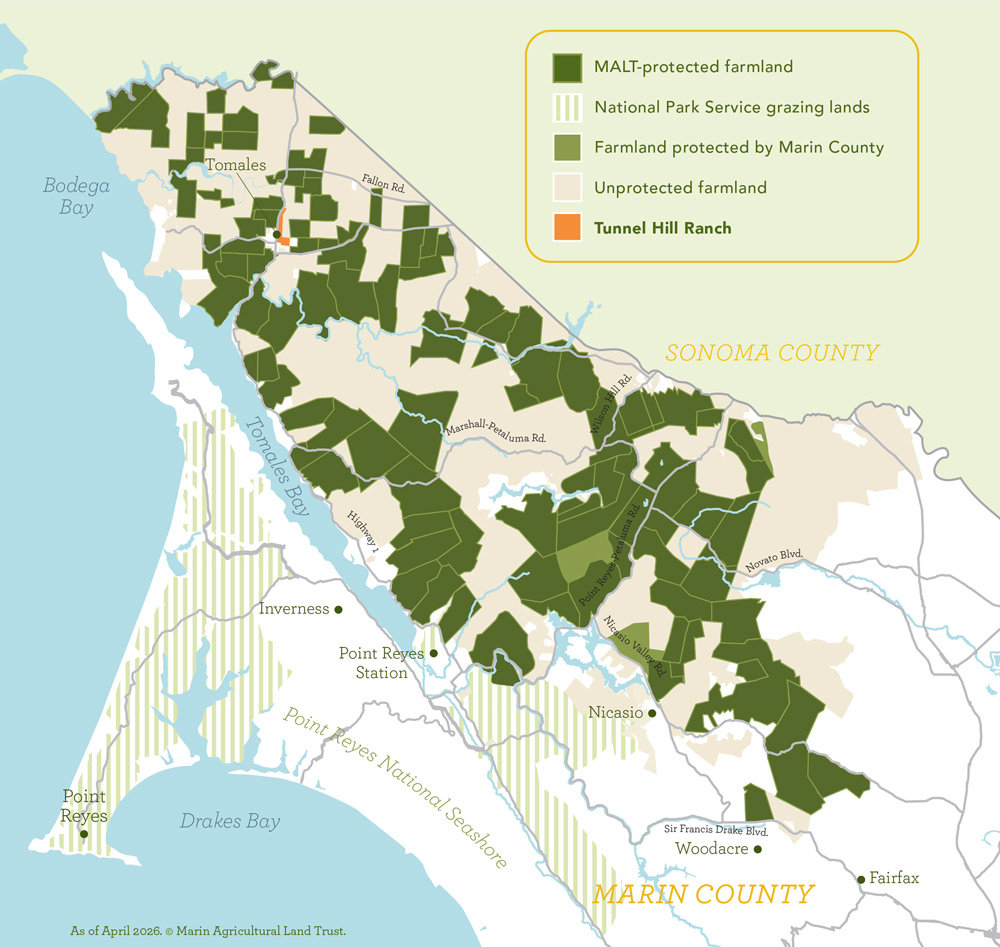
Once the easement is completed, Tunnel Hill Ranch will connect an 11,576-acre block of MALT-protected land surrounding Tomales. The property is bordered by the recently protected Parks Home Ranch and Parks Ranch, along with the Jensen Ranch — all secured with MALT agricultural conservation easements.
“Large, connected blocks of conserved agricultural land are essential for maintaining healthy ecosystems, supporting viable ranching operations, and providing wildlife with the room they need to move across the landscape,” said Lauren Faccinto, MALT’s Director of Conservation Programs. “Each easement we add strengthens the entire network.”
The protection of working agricultural lands like Tunnel Hill Ranch also contributes to California’s 30×30 initiative, which aims to conserve 30 percent of the state’s lands and coastal waters by 2030. Well-managed farmland provides critical habitat connectivity, carbon sequestration, and water quality benefits that support the state’s broader conservation goals.
Measure A: Marin’s Investment in Farmland Protection
Marin County’s Measure A program, a one-quarter of one-percent sales tax approved by voters in 2012 and renewed in 2022, dedicates up to 10 percent of its annual revenue to grants that fund agricultural conservation easement acquisition. The county will provide fifty percent of the Tunnel Hill Ranch easement acquisition funding, with MALT raising the remainder through private donations.
Since Measure A’s passage, the county has invested $22.9 million in farmland preservation. MALT has used these funds to help protect 18 farms and ranches totaling more than 11,149 acres — including 54 miles of streams, 6,651 acres of grassland, and operations ranging from beef cattle and dairy to row crops and pasture-raised eggs. The Tunnel Hill Ranch easement, valued at $1.1 million, will add to that legacy once closed.
Through MALT’s public-private funding model, tax-deductible contributions are often matched 1:1 with Measure A and other public agency funds, doubling the impact of privately-raised revenue. In total since 1980, MALT and its partners have invested $112 million in Marin County farmland conservation, protecting 58,917 acres on 98 ranches. Tunnel Hill Ranch will be MALT’s 99th easement.
“Measure A reflects Marin residents’ deep commitment to our agricultural heritage,” said Verdone. “When voters approved this funding and when individual donors step forward to match it, they’re investing in properties like Tunnel Hill Ranch — places that define our rural communities and ensure the next generation can continue farming and ranching here. It’s truly local dollars supporting local agriculture.”
Next Steps
MALT is working to finalize all aspects of the transaction with the Etemad family and expects to close the easement within the next few months — one more piece of the county’s farmland that Marin residents and MALT’s donors will soon have helped protect forever.
About MALT
The Marin Agricultural Land Trust (MALT) works every day to protect and steward Marin’s farmland to ensure the viability of agriculture and a healthy environment, now and forever. Since 1980, MALT has protected nearly 59,000 acres, about half of Marin’s privately owned productive agricultural land, on 98 farms and ranches through conservation easements. MALT’s stewardship programs provide financial and technical support to help Marin’s farmers and ranchers implement climate-smart practices, improve water quality, and build long-term agricultural viability.