Moira Kuhn: Building a Farm on Borrowed Ground

By Matt Dolkas,
Senior Manager, Marketing
February 23, 2026
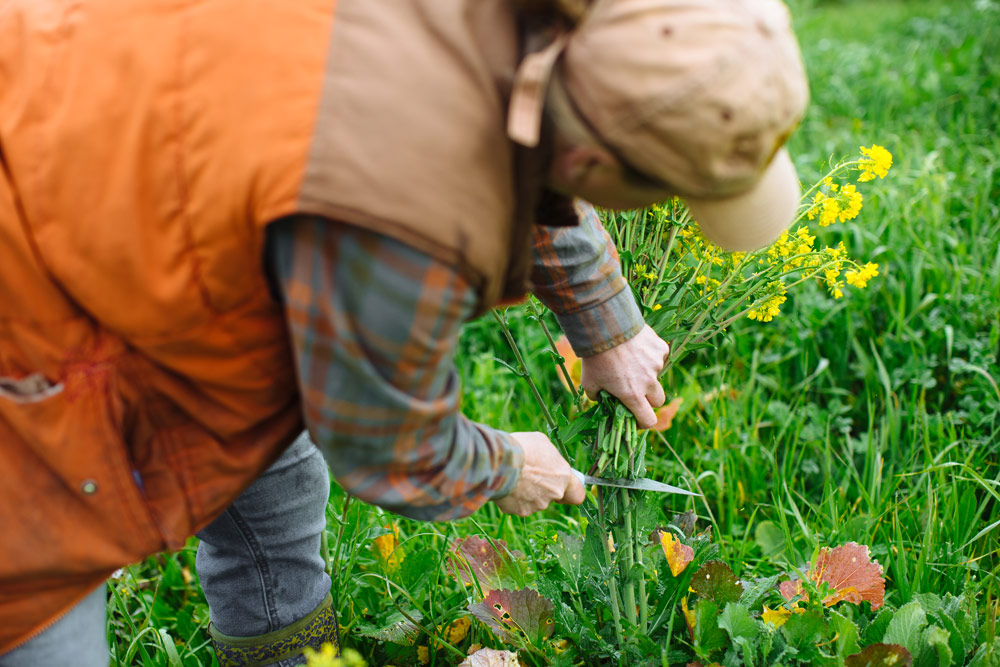
On a January morning at the MALT-protected Volpi Ranch near Petaluma, Moira Kuhn of Marin Roots Farm walks the field pulling cover crop radishes while she talks about what it takes to farm here. Her dog Poppy trots alongside, pausing for a scratch. The soil here has a lot of clay—some springs are so soggy they can’t get into the field until May—but Moira knows this ground now, its quirks and possibilities, what grows well and when.
Near the edge of the field sits a new greenhouse, doors hanging ready, tables inside waiting to be finished. Soon the space will fill with seedling trays. The investment makes sense—faster planting, reduced labor costs, the efficiency this 15-acre certified organic operation needs to survive. But there’s a problem Moira can’t solve: she’s installing all this infrastructure on land she’ll likely never own.
“We did this because it’s going to streamline things, make us more money—get us back into the black. There’s always a chance we won’t. But you invest anyway.” And Marin County is running out of farmers willing to take that gamble.
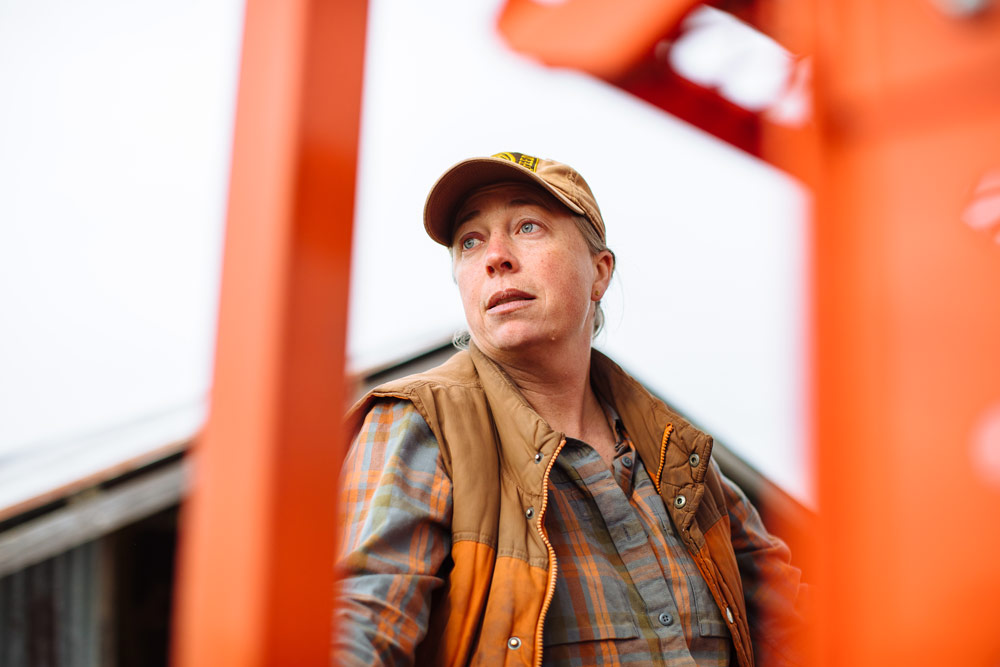
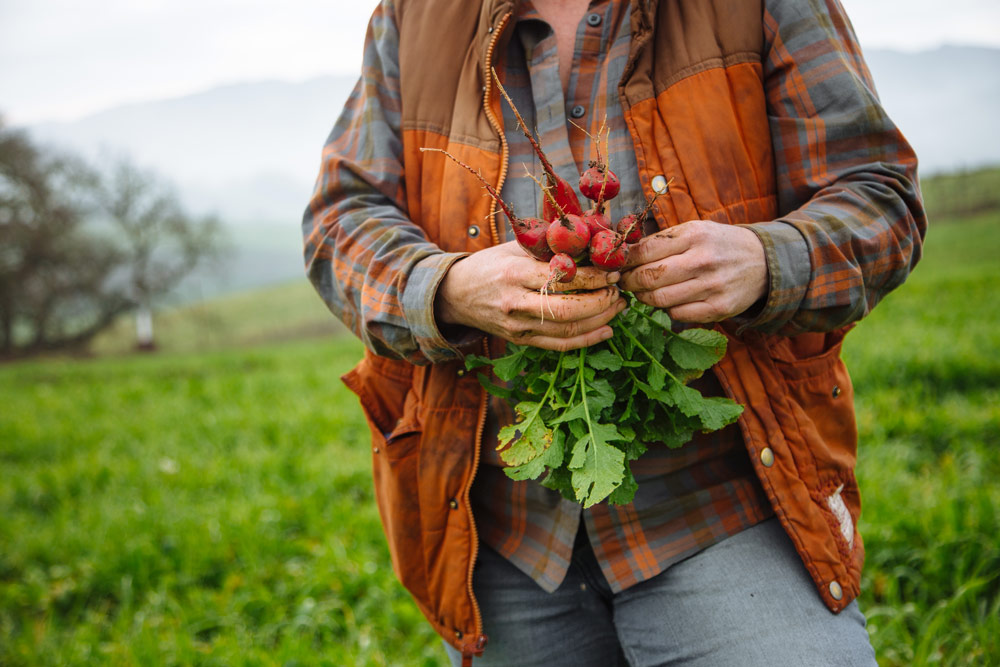 Moira with a freshly harvested bunch of cover crop radishes at the Volpi Ranch near Petaluma. Photos: Michael Woolsey
Building a Life on Borrowed Ground
Jesse started farming at the Volpi Ranch in 2002—made possible by the ranch’s owner, John Volpi, a dairyman who took a chance on leasing land to a newcomer. That kind of bet is how agriculture survives: older generations creating openings for younger ones willing to risk failure for the chance to succeed. John Volpi understood that prosperity doesn’t happen overnight in farming. It must be cultivated. Jesse and Moira are forever grateful for the opportunity he provided.
Moira came to farming years later through a college class about local food systems that took students on field trips to area farms. David Retsky at County Line Harvest asked if she was looking for work. She started part-time, then quickly full-time, then “more than full-time, which is some crazy hours, but some amazing experience.”
Eventually Jesse—by then her partner—wanted her to start farming with him. “What do you pay?” she asked. “Nothing,” he replied somewhat jokingly. They built a life together on leased ground, raising three children while mastering this particular soil.
They farm because they want to feed people. “What I’m growing and selling to my community is something that I want my family to be eating and I want their families to be eating,” Moira says. “I want to feel good about that.” It’s why they’ve been certified organic since day one, selling at farmers markets and creating deep relationships with customers who trust their no-spray approach.
And they thrive on innovation, working with Bay Area chefs who push them to try new things—mini root vegetables the size of a fingernail, edible flowers, a spinach mix made of eight different greens including orach, lamb’s quarters, and a Japanese variety that doesn’t even look like spinach.
Everything about their operation depends on being rooted—in this soil, in these relationships, in the accumulated knowledge of what grows where and when.
“People talk to me about what my succession plan is,” Moira says. “And I was like, what succession plan? I’m not going to pass a lease off to someone else.”
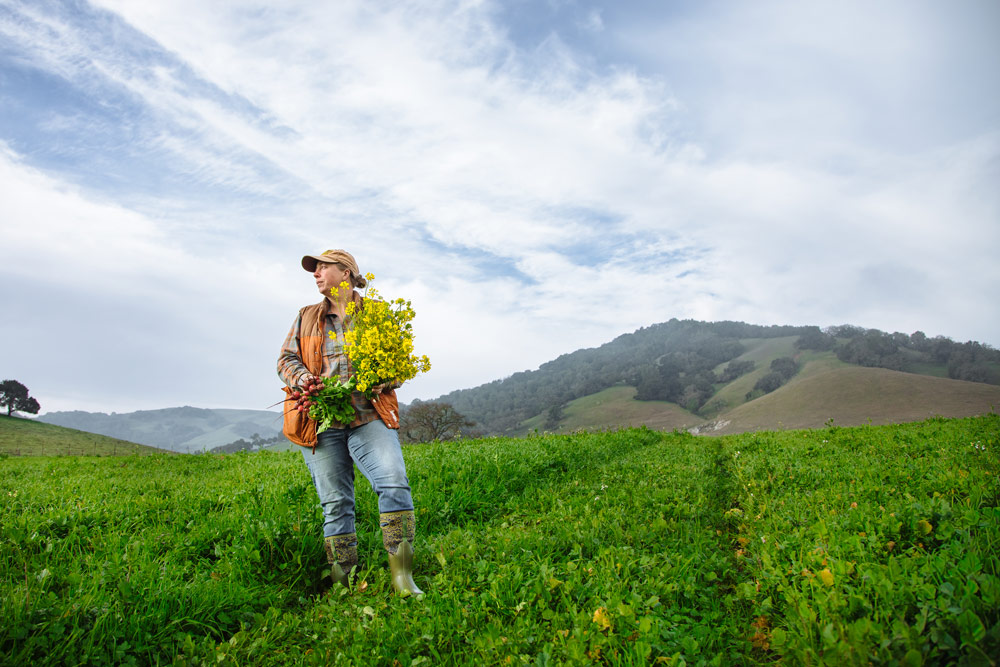
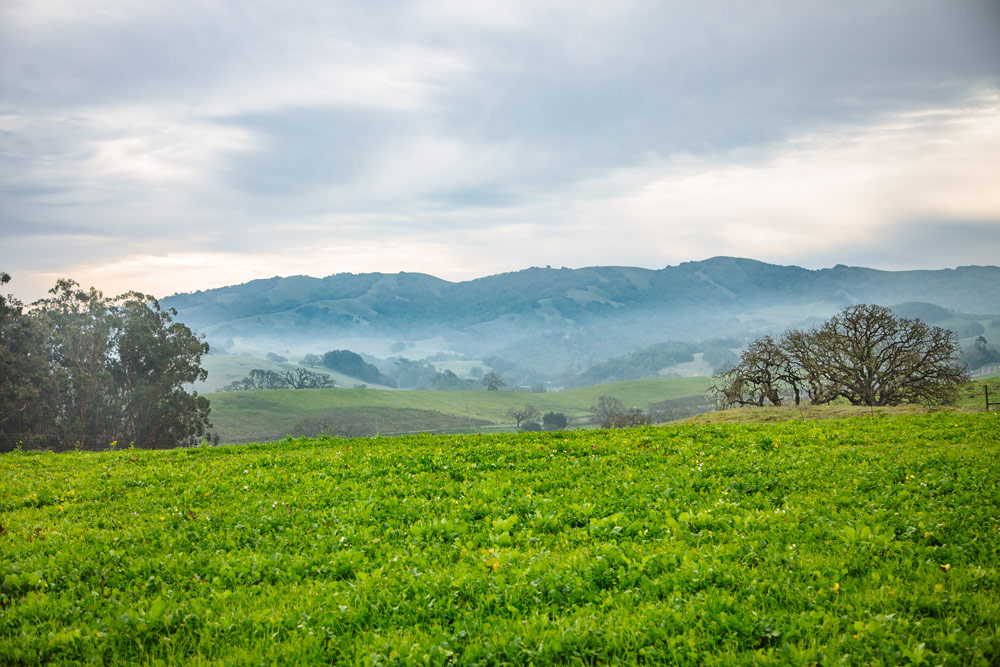 Winter cover crop fields at the MALT-protected Volpi Ranch near Petaluma. Photos: Michael Woolsey
The Ground Keeps Shifting
This kind of creative agriculture—the kind that makes Bay Area food culture distinct, that keeps heirloom varieties alive—requires stability. But for Moira and Jesse, the ground keeps shifting.
At one point they were farming 40-plus acres—the Volpi Ranch plus 30 acres at the Marin French Cheese Factory. When the cheese factory went through an ownership transition to a French corporation, they lost that land. Then came the 2021-22 drought. Water shortages shut down production on the home field entirely. All their culinary herbs—the whole front half of the field—died.
During the drought, Moira helped coordinate a MALT emergency grant through the Drought Resilience and Water Security (DRAWS) initiative to repair an old spring on the ranch. The water from the spring doesn’t serve Moira’s vegetable operation directly—it feeds the ranch’s goat dairy. But improved water security for the whole property matters when you’re farming on someone else’s land. You invest in infrastructure that benefits the ranch, knowing you might never see the full return.
“Jesse and I talk about there’s only so many new plots of land that we have in us to start,” Moira says. “We only have one or two more farms left to break in.”
The Quiet Disappearance
The numbers tell a stark story. In Marin County, farm production value has declined by $15.6 million over ten years. If you made a list of row crop farmers in Marin County today, you’d count around a dozen. Twenty years ago, that list would have been much longer.
It’s part of a larger pattern—California has lost more than 10% of its farms in the past decade.
Moira has watched the losses add up. Longtime vegetable farmers have scaled back or stopped selling commercially because they can’t find workers—very few of them can afford housing within commuting distance. Succession plans fail when the next generation can’t access land or can’t make the economics work. Operations close without much fanfare. The number of active farms just keeps shrinking.
“This quiet disappearance is really scary,” Moira says. “We’re going to wake up one day and realize that there’s only a few row crop farmers left, and it’s really hard to get people back into the area to farm.”
Impossible Math
Farmers without family land are the first to feel when the economics don’t add up. They don’t have family land to fall back on. They can’t absorb years of losses. They’re building from scratch in an economy where land prices have made traditional pathways to ownership nearly impossible.
But they’re also proof that the system can still work—and a glimpse of what agriculture’s future could look like with the right support. Moira and Jesse have built a viable operation on leased ground for over two decades. They’ve built relationships with chefs and customers, contributed to the local food system that supports 750 jobs and generates over $257 million annually in Marin County.
Whether the conditions that let them succeed can be replicated—or whether they’re the last generation that will get the chance—remains to be seen.
The support exists—technical assistance, climate resources, infrastructure grants. But first-generation farmers also need affordable land access, long-term lease security, and worker housing within commuting distance. And they need time to access what’s available, time that’s hard to find when you’re farming year-round on uncertain ground.
“This is not a let’s fix it in ten years,” Moira says. “This is now. People are leaving and they’re not going to come back.”
What Happens Next
MALT has permanently protected nearly 59,000 acres—well over half of Marin County’s privately owned productive agricultural land. The land is protected. But can the farmers and ranchers working this landscape survive?
MALT’s Strategic Framework now prioritizes expanding access to farmland alongside protection—working with ranchers to evaluate whether their land might suit specialty crop leases, exploring bridge loans and pathways to ownership, collaborating with housing organizations and agricultural training programs. Stewardship grants continue to provide direct support—more than $4 million to date for climate-smart practices, infrastructure improvements, and land management projects.
Marin County itself has stepped up. The new FARE (Food, Agriculture, and Resilient Ecosystems) grants—funded by Measure A—support everything from community gardens to increasing farmland access for underserved communities to carbon capture farming practices. It’s a recognition that sustainable food systems require coordinated investment.
The cavalry is here, in other words. But Moira’s story reflects something larger than any one program or organization can solve alone—a tangle of housing costs, land prices, and infrastructure needs that requires coordination across sectors and years of sustained investment.
The question isn’t whether farmers like Moira will keep showing up—they already are, building greenhouses on borrowed ground, making investments that might not pay off, working land without the security of ownership. The question is whether the systems that support them can evolve fast enough to let them stay.
Every acre protected, every farmer supported, every harvest made possible—it starts with you.