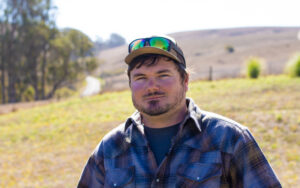
Bill Dellinger: A Tomales Rancher Is Writing His Own Grazing Playbook
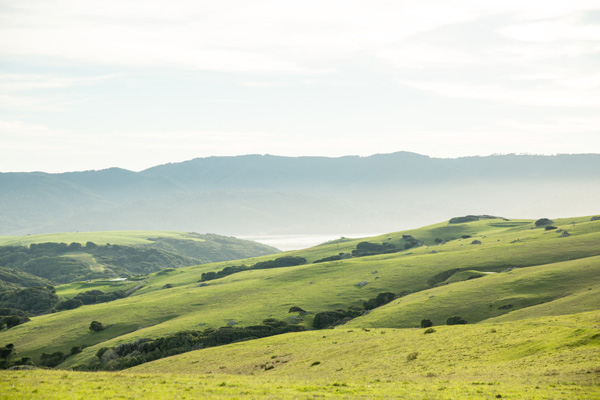
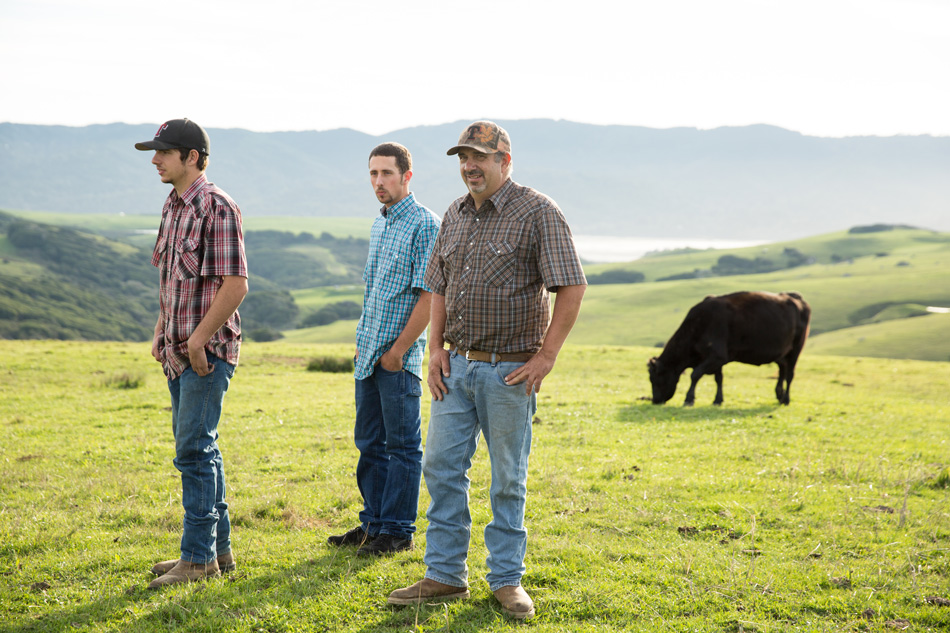
On the Ledger Ranch near Tomales, Bill Dellinger is making a deliberate bet on slow, dry-season grazing, built for the short growing season of California’s
It’s a number worth saying out loud. Forty-six years of work. 59,028 acres. More than half of Marin’s productive agricultural land, protected forever — the grasslands and creeks and coastline and working ranches that feed this region and will keep feeding it long after all of us are gone.
Between now and spring 2027, we’ll tell the story of how we got here — one farm at a time. Each month, a new place, a new family, a new answer to the question that has always been underneath this work:
What does land protection make possible?
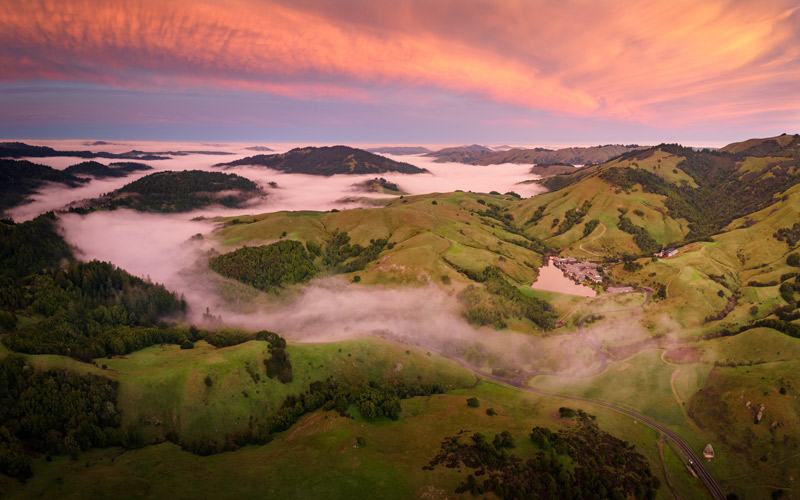
862 acres, Protected in 2014
Mike Giammona, pictured right, wanted this ranch since he was twelve years old.
He grew up in West Marin, started running cattle in 1993, and spent years leasing ground that would never be his — the way most young ranchers here spend their careers. Land you can work but never own. A life built on someone else’s terms. Then the ranch he’d dreamed of came up for sale. And it sold to a developer.
Eight hundred and sixty-two acres on the east shore of Tomales Bay, split into parcels, primed for estates with a view. For most young farmers, that’s where the story ends — priced out, shut out, watching the land you love become something else.
But MALT had been trying to protect this ranch for years. So, when the opportunity arose, we bought it — not to keep, but to hold, until the right people could take it on. For four years, Mike and his partner Andrew Zlot leased it and worked it back to health. Then, in 2018, MALT sold them the ranch with a conservation easement attached. The land was theirs. Permanently. And it could never be developed again.
Here’s what protection made possible. Mike’s son Morgan came home after college to raise pastured hens, now Tomales Bay Pastures, alongside the cattle — the next generation, on land that will still be a ranch when his own kids are grown. The creek that runs through the property is being restored for steelhead and coho. And a family that never thought they’d own anything now owns the thing they wanted most.
That’s the part people miss about conservation. Protecting the land isn’t the finish line. It’s the ground everything else gets built on — the next crop, the next idea, the next generation.
250 acres, Protected in 2021
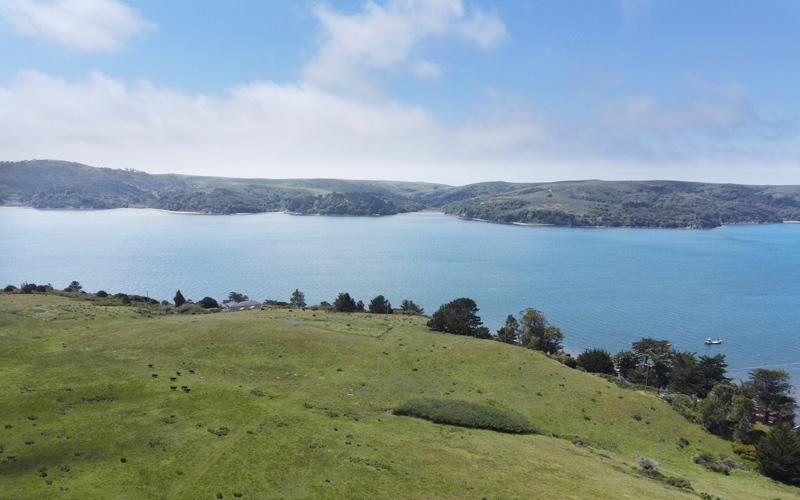
For nearly a century, the Leali family grazed beef and dairy cattle on 250 acres above the east shore of Tomales Bay. Rolling grass, rocky outcrops, springs running down through wooded draws to the tideline below. A classic West Marin ranch, until 2017, when it came into the hands of two oyster farmers.
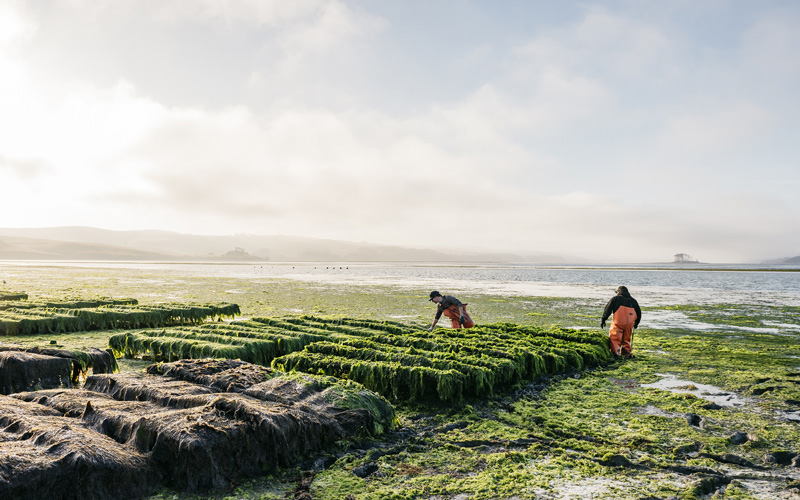
John Finger and Terry Sawyer started Hog Island Oyster Company in 1983 with $500 and a five-acre lease. Four decades later, it’s one of the most innovative food operations on the West Coast: a certified B Corp that farms oysters which filter and clean the very water they grow in, and a working climate lab, monitoring Tomales Bay’s chemistry alongside university scientists to understand what a warming, acidifying ocean means for the food we pull from it.
When Leali Ranch came up for sale, Hog Island bought it. Two hundred fifty acres adjoining their bayside operation, room to grow. Not to solely run cattle themselves, but because the land and the water are one system. Oysters take on the character of the bay they grow in, and the bay is shaped by the land around it. Protecting these hills was how they protected the water below, and everything they harvest from it.
Watch the video above and hear from Terry Sawyer, one of the owners of Hog Island Oyster Company and the Leali Ranch, about the significance of this first year of ownership and his philosophy of land stewardship.
Then the pandemic arrived, and the restaurant business that carried the company nearly went under.
That’s where MALT came in. In 2021, we purchased the development rights to Leali Ranch, permanently protecting it from ever being subdivided or built on, and structured the deal to close fast, at a moment when that mattered. It was the first easement MALT ever written to make room for mariculture, accommodating the shore-based infrastructure the oyster operation depends on while keeping the land in agriculture.
Today a local rancher leases the hills and grazes cattle on them, as the Leali family did for a hundred years. The oysters grow in the bay below.
Leali also builds on decades of protection along the east shore of Tomales Bay, joining an unbroken run of more than 10,000 protected acres — a continuous stretch of working coast, held whole. This is what protection makes possible: not a place frozen in time, but a place still at work.
2,538 acres, Protected in 1985
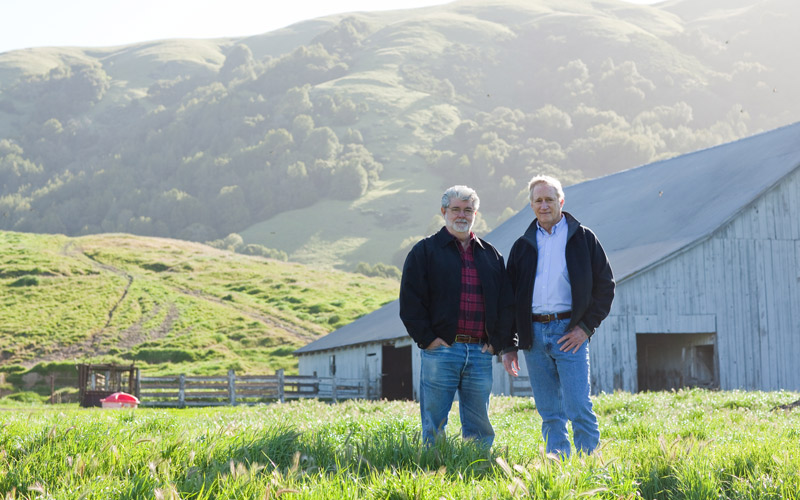
Two thousand plus acres is a lot of land to keep in one piece. That’s exactly the point. Among the largest and earliest properties MALT ever protected, this ranch in the Lucas Valley matters less for its size than for what its size makes possible. The easement was donated in 1985 by filmmaker George Lucas (pictured above with longtime MALT executive director, Bob Berner), back when most of West Marin was still unprotected and the idea of keeping farmland whole was still taking hold.
It’s a working ranch still. Cattle graze the hills, a vineyard works a corner of them.
But part of the reason a property like this matters reaches past its fences. From here, protected land stretches on nearly unbroken for miles. MALT’s easement gives way to other protected farmland, open spaces, and parkland. It’s a block of connected, undeveloped country large enough that wildlife can move through it freely, that whole watersheds stay intact, that the land goes on functioning the way it always has.
That connection is the quiet power of land protection at scale. A single easement protects a single ranch. But enough of them, side by side, add up to something larger — a continuous working landscape where agriculture has the room it needs to endure and the wildlife has the room it needs to roam.
Large blocks of protected land, like the Skywalker Ranch, provide the room local ranches need to sustain their businesses, and the room wildlife need to thrive.
In a changing climate, our connected open space is what lets the land absorb the shocks — fire, drought, flood. Intact watersheds hold and filter water, grazed grasslands store carbon and slow the spread of fire, and unbroken habitat gives wildlife somewhere to go as conditions shift. It’s the thinking behind California’s goal to conserve 30 percent of its lands and waters by 2030: scattered, isolated preserves aren’t enough; resilience depends on keeping large landscapes whole.
A ranch this size, protected this early, is a cornerstone of that work. Remove it from the map and the connection breaks — the block fragments, the corridor closes, the watersheds divide. Protected in 1985, it has anchored this stretch of the county for forty years, holding the middle while MALT added the pieces around it, one ranch at a time.
1,192 acres, Protected in 1993
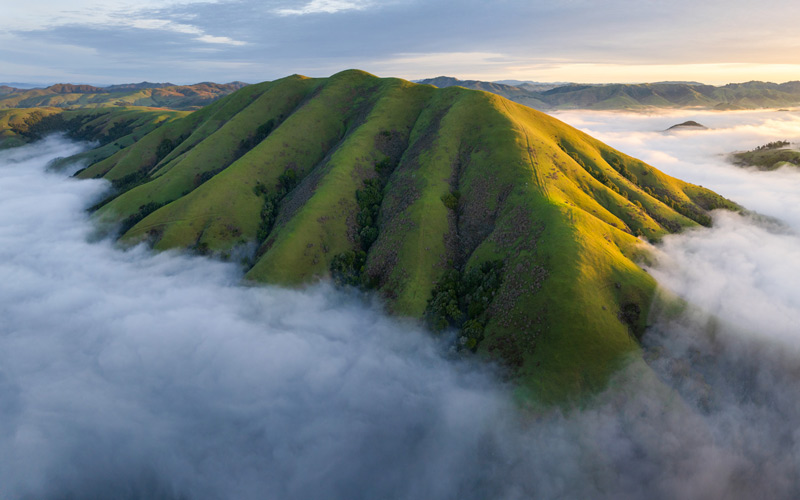
Black Mountain rises above Point Reyes Station, one of the most recognizable landmarks in West Marin — and one of the busiest working landscapes in the county. On its slopes, Stemple Creek Ranch grazes beef cattle. Allison Reilly keeps a flock of Jacob and Churro sheep and a herd of alpacas, raising wool and building soil, running a fashion studio from the ranch on the side.
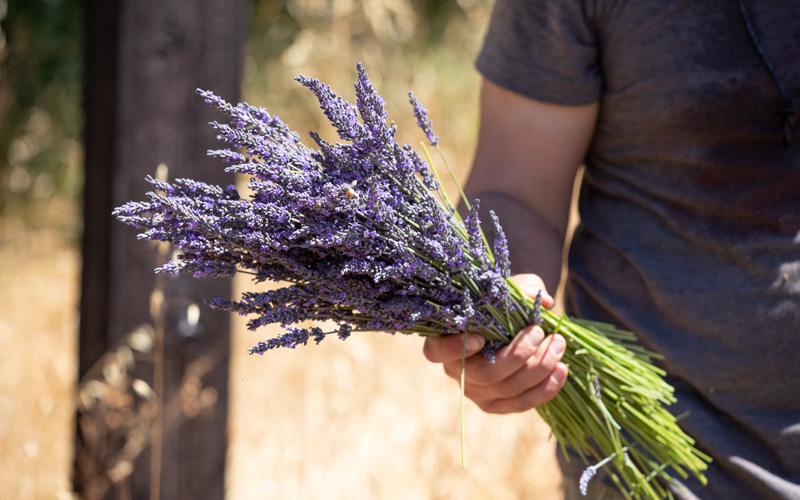
In a former quarry on a south-facing hillside, the Point Reyes Lavender Company grows lavender and presses it into balms and oils. Two small farms work row crops nearby, and Fibershed, the regional nonprofit behind the local fiber movement, brings its climate-beneficial agriculture work to the land alongside visiting students and soil scientists.
One mountain, many livelihoods — cattle, wool, lavender, crops, teaching — layered across the same protected ground.
That diversity is the vision of Marcel Houtzager, who took over the ranch in 2021 and has spent the years since turning it into a model of what a working ranch can be: not one operation, but a community of them, sharing infrastructure, knowledge, and a newly rebuilt three-story barn at the center of it all.
None of it would be possible if the land itself weren’t secure. MALT protected Black Mountain in 1993, guaranteeing it could never be subdivided or developed. What that permanence created wasn’t a landscape frozen in place — it was a foundation stable enough to build on. The easement locks in the agriculture. Everything else is free to grow, change, and try something new.
That’s the quiet surprise of conservation done right. People imagine an easement freezes a place in time. It does the opposite. Protect the land, and you give it room to go on living — grazed, farmed, and reinvented, generation after generation.
From a distance, Black Mountain looks much as it always has, its long ridgeline unbroken against the sky. Up close, it has never been more alive. This is what protection makes possible. Not a mountain held still, but a mountain held together — working, open, and full of life, for whoever comes along to tend it next.
Every month between now and spring 2027, we’ll add another farm, another family, another answer to the same question. Check back soon or sign up for our newsletter.
On the Ledger Ranch near Tomales, Bill Dellinger is making a deliberate bet on slow, dry-season grazing, built for the short growing season of California’s

There’s no better way to celebrate the holiday season than with food and fiber from right here in Marin County.
The Marin Agricultural Land Trust is applying for renewal of its land trust accreditation, and a public comment period is now open. The accreditation program