Chileno Valley Ranch: Balancing Family Ag and Environmental Stewardship
April 18, 2022
Nearly three decades ago, Sally and Mike Gale went almost instantly from living happily on Oahu in Hawaii—raising two daughters and one son, Sally working as a pediatric social worker and Mike as a federal agency administrator—to owning and working Chileno Valley Ranch in the heart of Marin, CA.
It wasn’t quite as random as it sounds. Sally’s family had operated multiple dairy ranches in Marin County for five generations, and growing up in the Sierra Nevada foothills she had spent holidays with family on those ranches. Still, it’s a big step from visiting for a few days at a time as a kid to making a living on a ranch.
“We had no experience with ranching when we took over Chileno Valley Ranch in 1993,” Sally said. “We were flying by the seat of our pants.”
Resurrecting a Dream
Sally had actually ‘chosen’ the Chileno Valley Ranch, when years earlier her mother had driven her around to the various ranches the family owned.
“I knew nothing about this ranch at that time,” she said. “But for some reason, I took one look at the tumbledown wreck of a house on this ranch and said, ‘I want this one.’”
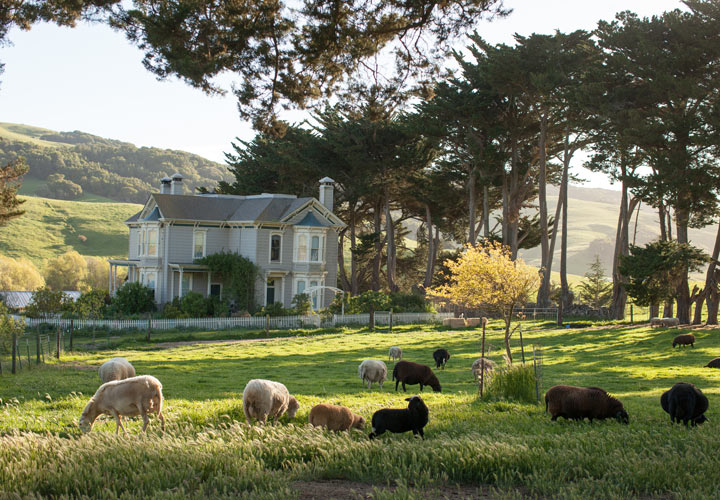
When she and Mike took possession of the 1880s ranch house—their three kids had already graduated from high school and were making their own ways in the world—it had no electricity, the fences were falling down, a freezer had leaked and fallen through the floor of the dining room, part of a staircase was broken and strewn about the yard, the elaborate Victorian-era door had been boarded up, and there were cows living inside the house.
It took Sally and Mike five years to restore the ranch house. They sold their house in Hawaii to help finance reconstruction of the Chileno Valley home, and they applied and were awarded financial assistance from the Natural Resources Conservation Service (NRCS) for cross fencing and a water system. Sally and Mike made recycled picket fence parts from salvaged wood from two torn-down old outbuildings, created a water system, brought in electricity, put in all the boundary fencing along the road themselves, and made the house livable.
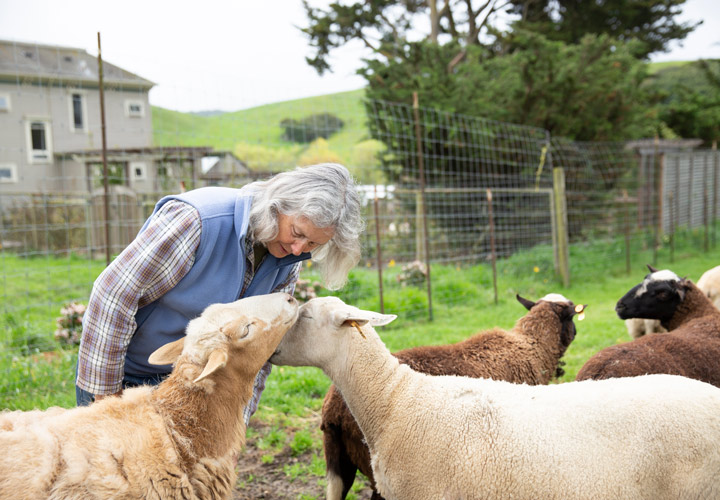
In the meantime, they attended workshops conducted by University of California Cooperative Extension (UCCE) of Marin County to help them decide what to do with the ranch’s 586 acres of steep hills and small pastures. The ag extension experts deemed animal agriculture as the “highest and best use” of the property. Sally and Mike didn’t have the upfront capital, nor did the ranch have the existing infrastructure to run a dairy, so they opted to raise beef cattle and started by buying six cows.
The Gales Meet MALT
Sally and Mike had known about the Marin Agricultural Land Trust (MALT) when they lived in Hawaii, happy that the faraway family ranches were being protected from the threat of subdivision and development. At one of the agricultural extension workshops they attended while getting established on Chileno Valley Ranch, Mike sat next to MALT co-founder Ellen Straus, so he invited her to visit the ranch.
“Ellen came over the next day, and she was actually very curious about what we were doing,” Sally said. “In fact, our first animal sale was to Ellen.”
About the time when Sally and Mike purchased their first cows, they met with Lisa Bush, who at that time was the only person at MALT doing land stewardship work.
“I had gotten to know the neighborhood a bit and I knew that some of the ranches were having trouble, so I gave some history to Lisa,” Sally said. “Lisa Bush was another incredible person, very knowledgeable and caring. I met with her and Ellen, just trying to help other ranches.”
Lisa suggested that Sally and Mike work with MALT to protect their ranch with an agricultural conservation easement for their Chileno Valley property—not only for the direct benefits of funds for further improvements, but also for other reasons that she explained.
MALT was going to be applying to the California Coastal Conservancy for a grant. Because of the work that Mike and Sally had done on their property with fencing, creek restoration, planting riparian areas, and other improvements, Ellen recommended MALT use Chileno Valley as a trial and example in the grant for some of the latest stewardship practices.
And so, in 2000, Chileno Valley Ranch became a MALT-protected property.
Protecting Land and Wildlife Remains Center Stage
Since Sally and Mike moved to Chileno Valley Ranch in 1993, the list of their accomplishments is long—and continues to grow. Some highlights include:
- Restoring their 1883 Romantic Italianate Victorian home into a neighborhood beacon.
- Building miles of fences, both as boundaries around their property and as cross-fencing to support rotational grazing of their cattle.
- Restoring creeks and native woodlands on their property.
- Establishing an efficient water system.
- Planting 400 heirloom apple trees that support a thriving U-Pick business each fall.
- Starting with their original six cows, growing and operating a grass-fed beef business.
- Serving as board members for local organizations including MALT, the Marin Resource Conservation District (Marin RCD), Marin Organic, the Marin County Farm Bureau, the Marin Conservation League, and Marin farmers’ markets.
- Operating a popular bed-and-breakfast and wedding venue on their ranch.
More recently, Sally founded and heads up the Chileno Valley Newt Brigade, which works to “create a science-based built solution to assist newts [in the Chileno Valley] in migrating to their breeding lake [Laguna Lake] safely.”
The Newt Brigade began three years ago. Sally and Mike were heading home around 10 p.m. from dinner at a neighbor’s house. Recognizing it was the kind of breeding-season night that the local California newts would be crossing the road to reach the laguna, Sally had Mike drop her off at one end of the laguna. She walked the one-mile stretch of road, picking up 45 dead newts and moving five live ones off the road, in the direction they were headed.
“That visceral, tactile experience did something to me, it affected me,” Sally said. “By the time I was done I said, dammit, I don’t know what, but I’m going to do something about this.”
What she did was invite to a meeting some of the “bright, capable people” she knew from her work with local agencies such as the Marin RCD, California Department of Fish and Wildlife, the Coastal Conservancy, and NRCS.
Now, just about every night during the three months of the newts’ breeding season, volunteers save the newts that are in danger of being run over by cars and collect scientific data about how activities in the surrounding area affect the newts and their habitat.
“When I look back, the things I’m most proud of all have to do with restoring creeks on ranches.”
– Sally
“I grew up in the mountains. My dad worked for the Forest Service, and my mother worked on the family ranch and was a fantastic gardener. I love the mountains and I love the ranches, and my love of the ranches had to do with my love of family.
Mike and I moved to Marin in 1993 in part so I could be with my parents as they aged,” she continued. “Unfortunately, my dad died just a few months after we got here, but my mother lived another 20 years. And it made me so happy to know how much my mom loved and appreciated everything we’ve done here at Chileno Valley Ranch.”
Support the Chileno Valley Ranch